A Devoko 3-Piece Patio Furniture Set Is a Layout Choice, Not a Seat Count
2026-09-16 · Ingrid Falk
-
The short answer: what a Devoko 3-piece set actually is
-
Same three pieces, three builds: bistro, wicker chairs, or folding chaise
-
Will it fit? What each layout asks of a porch or balcony
-
Wicker or metal base: what decides how many seasons you get
-
Where the $89.99 to $229.99 spread actually comes from
-
So which one? A rule you can reuse, and where it breaks
A Devoko 3-piece patio furniture set can be the right buy for a porch, balcony, or small patio, just not because of the number 3. Three pieces describes how many components ship in the box, not how many people can sit down, and it tells you almost nothing about cost. On one official listing page you can find a 3-piece bistro set with a coffee table advertised from $89.99 and a 3-piece wicker chair set at $199.99, more than double for the same piece count. What actually decides whether the set works for you is which of three layouts you are buying, and whether that layout's seat count, footprint, and base material match the space you have.
The short answer: what a Devoko 3-piece set actually is
A Devoko 3-piece set sits at the very bottom of the brand's piece-count ladder, and that position is the most useful thing to know about it. The same catalog runs a 9-piece and 11-piece patio dining set listed at $699.99 and discounted from $499.99, plus 5-piece sectionals at $399.99 and $444.99 depending on whether the base is plastic or updated metal, and 6-piece and 7-piece sectionals between $569.99 and $649.99. Three pieces is where the lineup starts, not a miniature of the bigger sets. Prices inside that 3-piece slot run from $89.99 to $229.99, which already spans the brand's entry and mid tiers. That spread inside a single piece count is the first thing worth noticing.
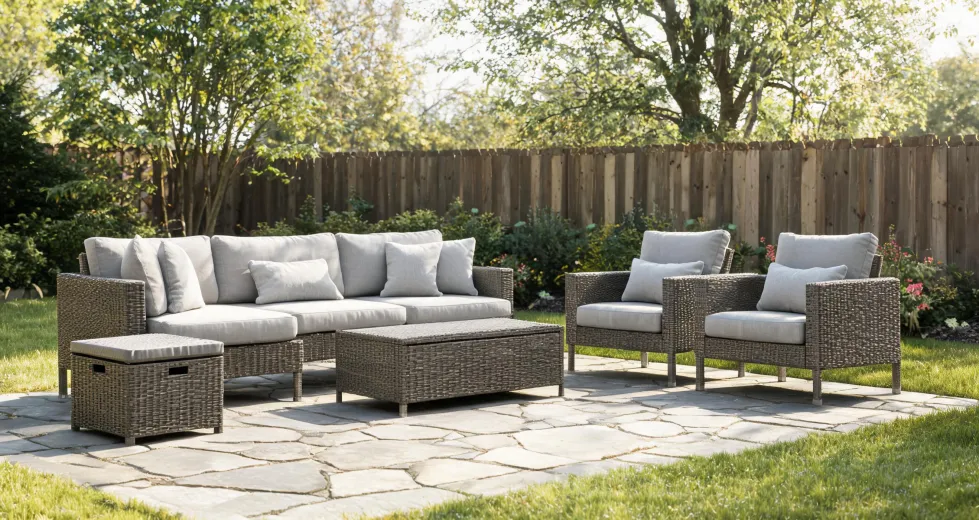
The reason 3-piece trips people up is that the label counts components, not seats. A bistro set is one small table plus two chairs. A wicker 3-piece group is three separate chairs with no shared surface at all. Both are honestly described as three pieces, and they seat two versus three people. The catalog itself spreads that label across the whole store rather than one category: the collections page sorts 389 products into 22 patio sectional sofas, 17 patio conversation sets, 9 lounge chairs, and 15 clearance items, so a search term like 3-piece can surface entries from several of those groups at once. Assume two seats unless the listing spells out three chairs.
So the number is settled: three pieces can mean two seats or three, and it never guarantees three. The next question is the one that actually narrows a search page. If a 3-piece bistro set, a 3-piece wicker chair set, and a 3-piece folding chaise all carry the same label, how do you tell which one belongs on your porch? The answer is not in the count, it is in the shape of the thing you are buying: whether it has a shared table, how many people it honestly seats, and whether the chairs can be pulled apart or have to stay clustered. Sort by shape first and the shortlist shrinks fast.
Same three pieces, three builds: bistro, wicker chairs, or folding chaise
The three routes are the bistro group with a coffee table, the wicker chair trio, and the rattan folding chaise set with adjustable backs, plus a rocking-chair trio listed at $229.99. On the official listing page, the 3-pieces patio bistro set with a coffee table for a front porch is listed at $169.99 and advertised from $89.99; the wicker 3 pcs front porch chair set is $199.99; the rattan adjustable-back cushioned folding chaise set is $309.99 from $189.99. The navigation splits seating into conversation sets, lounge chairs, and sectionals rather than into piece counts, which says the same thing: three pieces is a count that lands in more than one category.
Work out what you actually do outside before you compare prices. If the porch is where you drink coffee and set down a mug, the bistro route is the only one of the three with a flat shared surface, and it is also the smallest and the easiest to move indoors when the season ends. If you mostly want to sit and read with someone, three wicker chairs beat two chairs and a table, because each chair can go where the shade is. If afternoon naps are the point, the adjustable-back folding chaise route is the only one built for reclining, and it is also the priciest of the three at $309.99, promoted from $189.99. Layout follows habit, not budget.
Put the three routes side by side on four columns and the choice stops being abstract. Column one is what the set is: a table plus two chairs, three loose chairs, or reclining loungers. Column two is how many people sit at once, which is two for the bistro configuration and three for the chair trio. Column three is whether anyone gets a shared surface, and only the bistro group does. Column four is how the set stores: a bistro group folds into a small stack, loose chairs scatter into corners you already have, and chaise loungers take the most floor because they cannot be nested. Where a set cannot be broken apart, its footprint is fixed.
Will it fit? What each layout asks of a porch or balcony
Fit kills more orders than price does, and the answer starts with your own tape measure rather than the listing. Category pages are built as filters, not spec sheets: they group a store into conversation sets, sectional sofas, lounge chairs, and the rest, and they tell you which route a product belongs to, never how wide it is when assembled. Treat the category page as the tool that narrows your shortlist to one layout, then confirm assembled dimensions, seat height, and chair depth on the individual product page. Three measurements decide whether a 3-piece set lives on your balcony or in the return box.
Here is the scale to reason with. A three-piece bistro group needs roughly five feet of clear floor in each direction so both chairs can be pulled out, which is close to the span you would shade with the brand's 10 Ft cantilever umbrella if you wanted the whole group covered. The chair trio is friendlier to awkward spaces because it has no shared center: two chairs along the wall and one at the rail is a valid setup. The folding chaise set is the greediest of the three, since a reclining backrest needs clearance behind it. The storage side of the catalog measures space the same concrete way, stating an 82-gallon capacity instead of the word roomy.
Before you order, run three checks out loud. Measure the narrowest doorway the boxes must pass through, the depth from balcony rail to wall, and the wall length where the group will sit. Then check whether the chairs must be pulled out to be usable, because a bistro set with three feet of clearance in front is a table nobody can sit at. Finally, decide where the pieces live in winter: a group that has to be carried through a bedroom to storage is one you will use less than a group that folds and stays put. If any of those answers feels tight, the layout is wrong for the space, whatever the price says.
Wicker or metal base: what decides how many seasons you get
Base material, not piece count, separates a set you keep for five summers from one you replace in two. The clearest sign that the brand itself treats the base as the variable is in its own product names: the 5-piece outdoor sectional sofa with updated metal base is listed at $444.99 while the 5-piece with updated plastic base is $399.99, and that difference is written into the title rather than buried in a spec table. In the 3-piece tier you are choosing between wicker and rattan weaves over a frame and plainer metal or plastic bases, so ask what the frame is made of before you ask about colour or cushion thickness.
The strength language the brand uses elsewhere tells you what to look for. Its storage line describes an 82-gallon outdoor bench with a UV-resistant polypropylene body built to resist fading, cracks, and moisture, with a reinforced lid rated to 800 lbs, and its 85-gallon resin deck box is described as all-weather resin with a 660-pound seat rating. You are not buying a bench, but that is the same vocabulary used for outdoor seating frames, so it is fair to expect a seat listing to state UV resistance and a load figure, and to be sceptical when neither appears. Wicker weave over a stated frame is a different bet from weave over nothing you can verify.
So the verification step is short and specific. On the product page, find the frame material, whether fade or UV resistance is stated, and any load or weight capacity the listing gives; if a number is missing, treat the absence as a signal rather than a gap you will fill yourself. Then read the photos, because a tight-looking weave in a thumbnail can hide a thin frame. Keep that page open in a second tab while you compare the three routes, so material and price stay in view together rather than being checked from memory.
Where the $89.99 to $229.99 spread actually comes from
Ask why two 3-piece sets from the same brand can sit a hundred dollars apart, and the piece count stops explaining anything at all. Nothing about the three-piece label separates them, and the official price list makes that plain as soon as you read down it: the bistro group opens at $89.99 with a $169.99 list price, the wicker chair trio lands at $199.99, the rattan folding chaise reaches $309.99 from $189.99, and the rocking-chair trio sits at $229.99. Four three-piece sets, one label, one identical count, and a spread of more than double.
Put that beside the neighbouring piece counts and the illusion breaks. On the same page, a 4-piece patio set with a glass coffee table is $199.99 marked down to $189.99, so a four-piece set sits below a three-piece wicker group at $199.99. Further up, a 5-piece sectional is $399.99 in the plastic-base version, a 7-piece with ottoman is $619.99 reduced to $569.99, and the 9- and 11-piece dining sets sit at $699.99 down from $499.99. Piece count is not the price axis; shape and base material are, and the price follows them.
Discounts are the third variable and the least useful one for deciding. The store runs free shipping with the code devosale for five percent off, and the same listing page carries markdowns tagged at -47%, -39%, -29%, -18%, and -8% across different product groups. Sorting by price low to high, which the page offers, surfaces whichever item is deepest in markdown that week rather than the item that fits your porch. Buying the biggest discount on the page is how people end up with a lounger where they needed a table. Let a discount adjust the budget, never the layout.
So which one? A rule you can reuse, and where it breaks
Here is the question to answer before you add anything to a cart: where does the set live, and what happens in that spot on an ordinary evening? If someone sets down a drink, you need the bistro route's table. If two people sit down and a third joins now and then, you need chairs that separate. If the spot exists for lying back, only the chaise route does that. Everything else, colour, cushion fabric, and whichever discount happens to be live this week, is a tiebreaker between sets that already passed that test.
That gives you a usable rule: choose by layout first, base material second, and price third. In practice you filter the store by the collections that match your use, whether that is the patio conversation set, the lounge chair, or the patio sectional sofa listings, then verify frame material and any stated load rating on the product page, then compare prices knowing that shipping and taxes are calculated at checkout rather than shown in the tile price. The rule holds because piece count predicts neither price nor comfort, so each step removes a different kind of wrong answer instead of narrowing the same list twice.
Know where the rule breaks. It fails when your space is too tight for a table plus two pull-out chairs, because then the bistro route is out and separate chairs are the only honest option. It fails when you need shade, since a 3-piece set is seating and nothing else; an umbrella or a storage bench is a separate purchase and the $89.99 entry price covers neither. And it fails when four people will sit down regularly, because at that point a 4-piece at $189.99 or something larger is the real answer and three pieces was never going to be enough.
If you take one rule away, take this: a Devoko 3-piece patio furniture set is a count of components, not of seats, so match the layout to what you do in that spot and let the $89.99 to $229.99 band tell you which tier of that layout is affordable. A bistro group answers a need for a surface. A chair trio answers a need for seats that separate. A chaise group answers a wish to lie back. Check the frame and load rating on the product page, confirm the assembled footprint against your own measurements, and look at the discount last. Reverse that order and the savings stop being savings.

Ingrid Falk
Ingrid Falk is an outdoor living products analyst specializing in fences, pergolas, gazebos, canopies, greenhouses, shade sails, patio sets, outdoor sofas, and weatherproof cushions. She uses ISO 4892-2 and ASTM G154 weathering methods while comparing UV color change, coating adhesion, corrosion resistance, frame load, joint stability, water shedding, and dimensional movement. Her work helps garden retailers, project buyers, and hospitality operators select structures and furniture suited to wind exposure, climate, installation method, maintenance, and expected occupancy.