How to Read a Devoko Outdoor Chaise Lounge Set of 2 Before You Compare Prices
2026-09-16 · Ingrid Falk
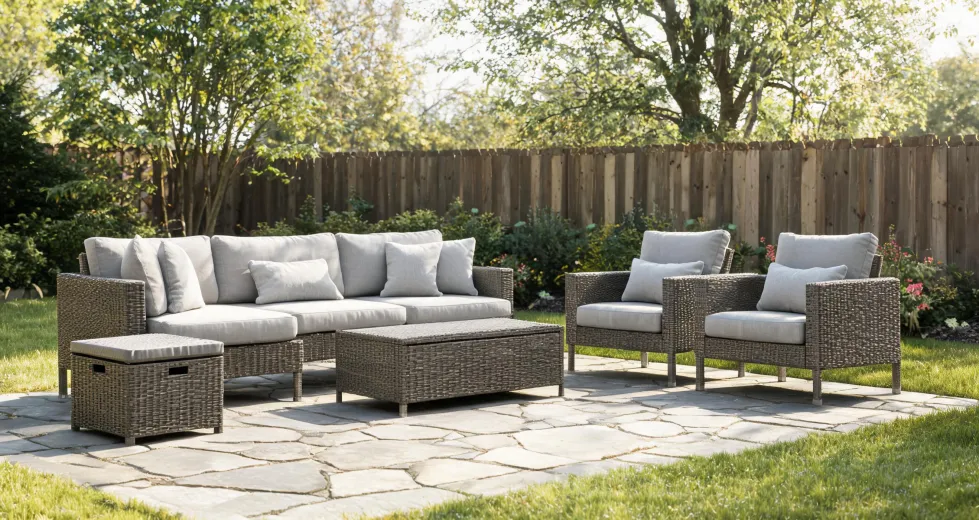
The short answer: a Devoko outdoor chaise lounge chair set of 2 is a floor-space and recline decision, not a style or discount decision. What actually decides whether you enjoy the purchase is whether you can give two seats a continuous run of patio, and whether the back adjusts far enough for the way you lie down — the rattan finish and the markdown badge are secondary to both. Everything else in this category, from piece counts in listing titles to umbrella bases and storage capacity, is downstream of those two variables.
What "Set of 2" Actually Means in the Devoko Chaise Lounge Line
Which raises the question you should answer before you compare any single price: when a Devoko listing title reads '3 Pieces' or '3 Pcs' and your search reads 'set of 2,' are those the same count? They are not, and the distance between the two is where most of the confusion in this category lives. One of the brand's own entries, named 'Devoko Patio Chaise Lounge Sets Outdoor Rattan Adjustable Back 3 Pieces Cushioned Patio Folding Chaise Lounge, Back Adjustable - Beige,' is listed from $189.99. Read that name slowly and you find three separate facts stacked in one line: a set-level piece count, a chair-level capability, and a form factor. None of them tells you how many loungers you receive, and the phrase you searched with — set of 2 — appears nowhere in the title. That mismatch is not a trick; it is how patio furniture gets named across the category, where the unit of sale is often an assembly of seat, frame, cushion and table rather than one chair. Pull those three facts apart and the rest of the purchase, umbrella and storage and checkout code included, falls into a sequence you can follow.
Devoko's collections page is what turns this from a wording quirk into a buying instruction. The catalog organizes lounging into two separate sets: Lounge Chair, which holds 9 products, and Patio Zero Gravity Chair, which holds 7 products. Two collections, two reclining mechanisms, one word — lounging — that you and the catalog both use. That split tells you 'chaise lounge' is not a product on this site; it is a label covering two ways of lying back. The consequence is practical rather than semantic. Land on an item from the zero-gravity collection and you are buying into a different recline geometry and a different seat suspension than the adjustable-back, folding lounger line gives you. Nothing in a product title flags which collection you are in, because the title says '3 Pieces' and not 'zero gravity.' The collection name is the only reliable signal, which makes it the first thing to check and the last thing to assume.
Here is the condition that lets you skip the rest of the deliberation. If you already know you want a back you can sit up in for a drink and lay flat for a nap, and you can give the pair an uninterrupted stretch of roughly five feet along a wall or railing, the paired format in the listing is adequate and you can move straight to allocating budget between the chairs and everything that supports them. If, instead, the picture in your head when you say lounging is a deep, near-horizontal float with your legs above your hips, stop comparing prices and go confirm which collection carries that recline, because the same search phrase reaches both and only one will match. The cost of getting this wrong is not measured in dollars saved or lost; it is measured in how many afternoons you never end up sitting down.
Why an Adjustable Back and a Rattan Frame Change How You Use Them
Why does an adjustable back change when you are willing to sit down at all? Because a chaise with a fixed back holds exactly one posture, and that posture has to survive the entire afternoon. The entry named above stacks an adjustable back and a folding form into the same title, and those two features answer different questions. Adjustment answers the posture question: reclined for reading at four o'clock, near-upright when someone walks over, without hauling furniture around or wedging a cushion behind your shoulders. Folding answers the aftermath question: what happens in the twenty minutes before a storm front, and what happens in November when the patio stops functioning as a room. Neither feature makes the seat more comfortable in any measurable sense. What they do is raise the number of hours in which sitting there is the easy choice instead of a small negotiation. A fixed-back lounger can be perfectly comfortable and still get used a third as often, because one posture has to serve lunch, reading, and a nap.
Frame and base material is the other half of that mechanism. On the same storefront, the brand sells near-identical configurations twice with the base called out in the product name: one listing carries an updated metal base, its sibling carries an updated plastic base. Naming it at all is the signal — this is a decision, not a default. Metal bases carry the load paths a heavier frame wants and hold their geometry through repeated thermal cycling; plastic bases are lighter to reposition, do not rust at the joint, and are typically where the lower-priced version of a given configuration sits. For a pair of reclining loungers the base is what takes the twist every time you drop your weight back into the seat. A rattan weave over a light base photographs identically and can feel fine in year one. The base is what determines whether the same unit still sits level after two wet seasons, and that is a maintenance question before it is an aesthetic one.
Then the condition boundary on the fold itself. Folding form only pays off if there is somewhere to put the folded object. On a balcony with a closet, or with an interior hallway a few steps from the door, folding loungers convert a two-chair patio into usable floor space whenever the weather turns, and that conversion is most of what you paid for. With no indoor staging spot — a ground-level terrace behind a locked gate, a yard where the only dry space is already full of other things — the fold becomes a feature you exercise twice a year while the seat has to survive outdoors regardless. In that second case the seasonal question stops being how the chair folds and becomes where the chair stands, and the answer moves the budget more than the chair model does.
Footprint, Storage, and the Add-Ons That Change the Real Price
Beyond the price tag on the chair, how much plane and depth are you actually committing? Two adjustable-back loungers need a continuous run along a wall or railing, plus enough depth behind them for the back to travel through its recline range. If that run sits in open sun it also has to accommodate shade, because a lounger you cannot lie on after ten in the morning is furniture you use for two hours a day. Devoko sells that shade as its own line item: a 10 Ft cantilever umbrella at $109.99, offset-hanging rather than center-pole. The offset geometry is the part that matters in this calculation. A center-pole umbrella has to stand in the middle of the space you are lounging in, breaking up exactly the continuous run two seats need; a cantilever arm moves the mast to one side and reaches the canopy across both. So the space question is never two chairs. It is two chairs plus a weighted base plate off to one side, and the plate needs somewhere to live.
The dry-storage side of the same problem carries its own line in the budget, and the brand's catalog hands you the comparison directly. The 82 Gallon Outdoor Storage Bench is built from UV-resistant polypropylene with a reinforced lid rated at 800 lbs; capacity and load rating together describe a unit that holds cushions, hardware and seasonal covers while still functioning as a seat. A smaller resin deck box elsewhere in the same catalog trades that capacity and that seat rating downward, which is the point of reading the specs rather than the photograph. The trade is worth framing precisely: you are not buying a box, you are buying whether rattan and cushions stay dry where they sit or migrate indoors every time the forecast changes. Capacity answers how much stays outside. The lid rating answers whether you lose a seat to gain the storage, or keep both.
A boundary worth stating plainly, because it is where people spend decision energy that moves nothing: checkout terms are not product decisions. Free Shipping, the 5% OFF With Code: devosale banner, and support hours of Monday-Friday 9:00-17:00 EST all sit on top of the purchase. They change what you pay and who you contact when something goes wrong. They change nothing about how much floor the chairs occupy, how far the back travels, or whether the cushions have a dry home in July. The collections structure works the same way: Lounge Chair as one nine-item set and Patio Zero Gravity Chair as a separate seven-item set is a browsing fact, not a discount event. Apply a code to the wrong line and you have saved five percent on furniture that does not fit the space you have.
The Rule to Apply Before You Buy the Pair
So the rule to apply, in order, before you pay for any pair. First, align the count: decide how many separate loungers you are buying, check it against the listing's set-level figure, then confirm which collection the item sits in, because the adjustable rattan entry lists at $309.99 and belongs to one tier while the zero-gravity set is a different collection with a different recline. Second, cost the space instead of the seat alone: add the cantilever umbrella's footprint and price and the storage bench's footprint and price to the chair budget — the bench is listed from $179.99 — before deciding the chairs are affordable, because a pair with no shade and no dry storage is a pair you stop using by midsummer. Third and last, compare the discount labels, and only among items that survived the first two steps. Discounts are the easiest thing to compare and the least informative.
Where the rule runs out, and where you have to go back to the source instead of reasoning forward from a title: individual seat dimensions, cushion thickness and fill, and whether an accessory ships in the same order as the furniture. The listing name tells you the piece count and the adjustable back. In this context the count covers the whole assembly rather than a number of loungers, and it says nothing about how wide one seat is, how far the back actually travels, or what the cushions are made of — the three measurements that decide whether both people using the patio fit. It also does not tell you whether the umbrella and the bench arrive on the same delivery as the chairs. Confirm per-seat measurements, cushion spec and shipping composition against the live product page before committing. Everything above is the frame; those confirmations are the load.
The rule, then, is to buy the reclining line first, the support items second, and the discount last. A Devoko outdoor chaise lounge chair set of 2 is decided by how much continuous patio you can dedicate, which of the two lounging collections matches the posture you actually want, and whether shade and dry storage sit inside the same budget as the chairs. Answer those three and the checkout code is what it should be — a small adjustment at the end of the decision. Skip them and no percentage off keeps two rattan loungers and their cushions usable through a wet season.

Ingrid Falk
Ingrid Falk is an outdoor living products analyst specializing in fences, pergolas, gazebos, canopies, greenhouses, shade sails, patio sets, outdoor sofas, and weatherproof cushions. She uses ISO 4892-2 and ASTM G154 weathering methods while comparing UV color change, coating adhesion, corrosion resistance, frame load, joint stability, water shedding, and dimensional movement. Her work helps garden retailers, project buyers, and hospitality operators select structures and furniture suited to wind exposure, climate, installation method, maintenance, and expected occupancy.