What a Devoko Rattan Chaise Lounge Set of Two Really Decides for Your Patio
2026-09-16 · Ingrid Falk
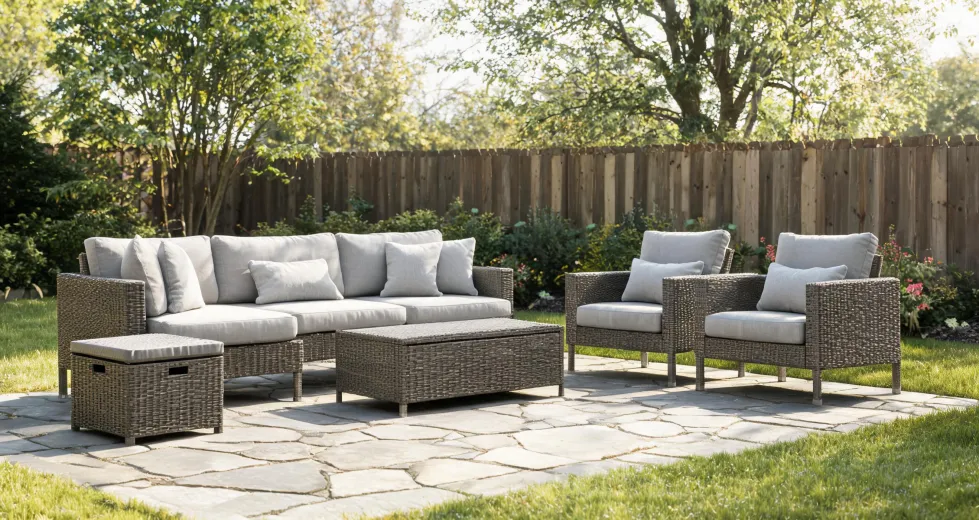
Two chairs are not the decision; the build is. In this catalog a chaise shows up as a rattan-framed, adjustable-back, cushioned piece sold inside a set — the brand's own listing shows a rattan adjustable-back cushioned folding chaise lounge grouped in a 3-piece set listed at $309.99 and offered from $189.99. That means the word "set" is covering three separate things: how many seats, whether the back reclines, and whether cushions come with it. Price those three apart before you compare them with any other patio group. Decide structure and floor space first and the chair count falls out of your answer. Decide the count first and you spend the same money learning that your patio sits in full sun at three in the afternoon and has nowhere dry to stack anything in November, because shade and storage are sold on their own pages in this same store.
What a Two-Chair Chaise Pairing Actually Decides in This Catalog
Before you compare a two-chair chaise pairing with anything else, settle what the phrase is actually asking you to choose. A set of two answers a question about quantity, and quantity is only one of three variables that travel together in this category: the number of seats, the reclining mechanism, and whether cushions are part of the box. Treat the count as the whole deal and you will price two chairs against three chairs, when the more useful comparison is adjustable against fixed, and cushioned against bare frame. So the opening move is not to hunt for the lowest pair. It is to name which of the three you cannot give up — a second seat, an adjustable back, or an included cushion — because that answer decides what the rest of your budget is even allowed to buy.
Here is the structural reason that reframe holds. On the store's collections page, reclining seating is broken out as its own run of shelves rather than a footnote to the sofa line: Lounge Chair lists 9 products, Patio Zero Gravity Chair 7 products, Patio Daybed 4 products, and the wider Patio Sectional Sofa group 22 products, inside a catalog that runs to 389 products. What that tells you is that a chaise is a category you shop, not an accessory you add to a sofa order. Start from the sectional group and you will find yourself weighing corner sections and seat depth; start from the lounge group and the questions become back angle, folding, and cushion. Both are patio seating and both are legitimate, but they answer different problems. Ten minutes spent in the wrong group is how a two-chair purchase turns into a three-piece sectional you never wanted.
The condition that confirms this is what actually sits on the shelf: a set with an adjustable back rather than a bare chair retailed one at a time. The listing reads as a rattan adjustable-back cushioned folding chaise lounge, grouped into a 3-piece set, listed at $309.99 and currently offered at $189.99. Two consequences follow. First, count and mechanism arrive bundled — you are not choosing between two chairs and two chairs with a reclining back, because the reclining back is part of how the item is built and sold. Second, the discount attaches to the set, not to a single chair, so per-chair math only becomes meaningful after you know what the set contains. If you find a cheaper pair elsewhere, expect it to differ on the back or on whether cushions are included, and value those differences before you value the price.
Where the Rattan Frame and Adjustable Back Change Your Afternoon
Why does the build matter more than the count on an ordinary afternoon? Because the two features that decide whether you stay outside for twenty minutes or two hours are structural, not numerical. A rattan frame plus a cushioned, adjustable back is what lets the same chair serve two positions in one day: upright with a drink in hand at four o'clock, reclined and settled at six. In this store that combination is exactly how the chaise is described and grouped: rattan frame, reclining back, cushions included, folding, sold in a three-piece grouping at $309.99 and marked down from $189.99. A second chair with a fixed back gives you somewhere to sit; an adjustable back on two chairs gives you somewhere to spend the late afternoon. The count sets capacity, and the mechanism sets duration, which is the variable you actually notice when the sun drops.
The effect shows up in how a patio afternoon is paced. With a fixed-back pair, the day holds one usable position: you sit while it is comfortable and go inside when it is not, and the chair does nothing to help you adapt. With an adjustable back, the same footprint covers a conversation position, a reading position, and a near-flat position, so the seat keeps working as the light shifts and as your own energy drops. A cushion extends that range further, because a reclined body presses more of itself against the frame, and a bare frame becomes uncomfortable long before the hinge does. None of this adds a chair or moves a railing. It changes how many hours the pair you already own can absorb, which is why the mechanism should be locked before you weigh whether a third seat is worth buying.
The price structure on this sales floor confirms where the money actually goes: pieces, not materials. The 9-piece and 11-piece dining group is listed at $699.99 and from $499.99; the 6-piece sectional appears at $599.99 and $489.99; the 7-piece at $649.99 and $569.99; the 5-piece at $444.99 and $399.99. Down in the small groups, a 3-piece bistro set is $169.99 and from $89.99, and a 4-piece set with a glass coffee table is $199.99, marked to $189.99 — the same order of money as the chaise sets. Read that ladder and the intuition that one frame material costs more than another falls apart. What lifts a total is how many pieces are in the box and what structure they carry. Applied here, the honest question about a chaise pair is not which frame is fancier; it is whether the adjustable, cushioned build is in the piece you are paying for.
When Storage and Shade, Not Chair Count, Decide the Purchase
The first outside constraint is where the chairs go in November. Storage is not bundled with seating here — the store sells it as its own line, with an 82-gallon storage patio bench and deck box from $179.99 and an 85-gallon resin wood-look deck box at $99.99, the latter rated for 660 pounds of seating, its reinforced lid rated to 800 pounds. Notice the second use: these boxes are benches as well as containers, so what you buy for winter storage can double as the seat you use during the season. That changes the arithmetic. If your patio has no closet, no shed, and no basement door, the storage line is not an optional add-on to a chaise purchase; it is the item that makes the chaise purchase survive the off-season, and it belongs in the budget before the second chair does.
Shade is the second outside variable, and it is priced separately too. The store's navigation keeps Umbrella & Canopy as its own line beside Lounge Chair, and the flagship item there is a 10 Ft patio cantilever umbrella at $109.99 — an offset hanging market umbrella described exactly for people bothered by the sun while resting on outdoor furniture. Nothing in the chaise listing covers that gap. So before you assume two chairs add up to a lounging spot, ask which direction your patio faces and what stands between it and the sun at three in the afternoon. If the answer is nothing, you are buying chairs for the hours the seat is not in full glare, and the umbrella is the purchase that converts those chairs into an all-afternoon option.
The trade-off, then, is not chairs against shade in the abstract; it is sequence. Look again at how the collections page organizes this store: separate shelves for Lounge Chair, Patio Zero Gravity Chair, Patio Daybed, Patio Umbrella & Canopy, Garden, all inside that 389-product catalog. Each shelf is a decision you make before the next one, and the order you take them in decides what you can still afford. Take the chairs first and the umbrella and the storage box become leftovers competing for whatever remains; take the space first — a shaded position plus a dry place to stack things — and the chair budget shrinks to a real number you can then spend on structure rather than on a third seat nobody asked for.
How to Verify a Two-Chair Chaise Set Before You Order
Before ordering, run the same three checks the store's own filtering implies. First, filter to the right line instead of scrolling the whole catalog: the product listing offers sorting and per-page views precisely because 389 products is too many to browse, and chaise comparisons belong in the lounge seating group. Second, read the piece count and the box contents in the title rather than the photo — 3 Pieces and 4 Pieces are count statements, and a folding chaise listed as part of a set is not the same purchase as a single recliner. Third, confirm the two companions in the same session: check whether an umbrella in the 10 Ft range and a deck box in the 82- to 85-gallon range are available in the finish you want, because a chair decision that ignores them is only half made.
One plausible misreading is worth removing now: that a chaise pair can be judged with the same logic you would use for a sectional sofa. The catalog's navigation keeps those apart — SECTIONAL SOFA, PATIO DAYBED, CONVERSATION SET, DINING SET, LOUNGE CHAIR, UMBRELLA & CANOPY sit as parallel entries, and the products under them behave differently: sectionals are sold by piece count and base type at $399.99 and $444.99, dining groups by seat count and table length at $699.99 and from $499.99. A chaise is core hardware for one person lying down, so its limiting questions are back angle, cushion, and where it folds. Buying a two-chair chaise with sofa logic pushes you toward more seats and bigger footprints; buying it with lounge logic pushes you toward the mechanism and the space around it.
So the rule to carry into the cart is a sequence, not a comparison: fix the floor first, then the furniture. Name the shaded spot and the dry storage spot on your patio before you name a chair count, because those two conditions are the ones you cannot negotiate with later. Then spend what remains on the mechanism in front of you — an adjustable back and a cushion on the seats you will actually recline in — and let the count follow from how much clear space is left, not from how large a set looks in a photo. If that leaves you with two good chairs instead of three, you have still bought the version you will use every clear afternoon rather than the version you will store for half the year.
Two chairs, one shaded spot, one dry spot — that is the whole purchase, and it folds into a single test you can apply in the time it takes to read a listing. Ask which constraint binds first. If the sun reaches your patio all afternoon, the umbrella comes before the second seat; if there is nowhere dry to stack anything, the deck box comes before the second seat; if both are already handled, the remaining money belongs on the adjustable, cushioned build rather than on a third chair. The phrase set of two was never the decision. It was the count at the end of a decision about structure and the space around it, and that is the order in which a patio that gets used actually gets furnished.

Ingrid Falk
Ingrid Falk is an outdoor living products analyst specializing in fences, pergolas, gazebos, canopies, greenhouses, shade sails, patio sets, outdoor sofas, and weatherproof cushions. She uses ISO 4892-2 and ASTM G154 weathering methods while comparing UV color change, coating adhesion, corrosion resistance, frame load, joint stability, water shedding, and dimensional movement. Her work helps garden retailers, project buyers, and hospitality operators select structures and furniture suited to wind exposure, climate, installation method, maintenance, and expected occupancy.