How to Choose devoko Patio Seating: Bases, Piece Counts and Price Tiers
2026-09-16 · Ingrid Falk
-
5 Pieces or 7 Pieces: What to Compare First in a Wicker Patio Conversation Set
-
Same Five Pieces, Two Bases: Updated Metal Base vs Updated Plastic Base
-
Piece Count vs Footprint: Which Configuration Fits Which Patio
-
$169.99 to $699.99: Why Discount Percentages Never Line Up With Price Tiers
-
The Seating Set vs the Whole System: Accessories That Decide Usability
-
The Decision Rule: Three Checks Before You Compare Price
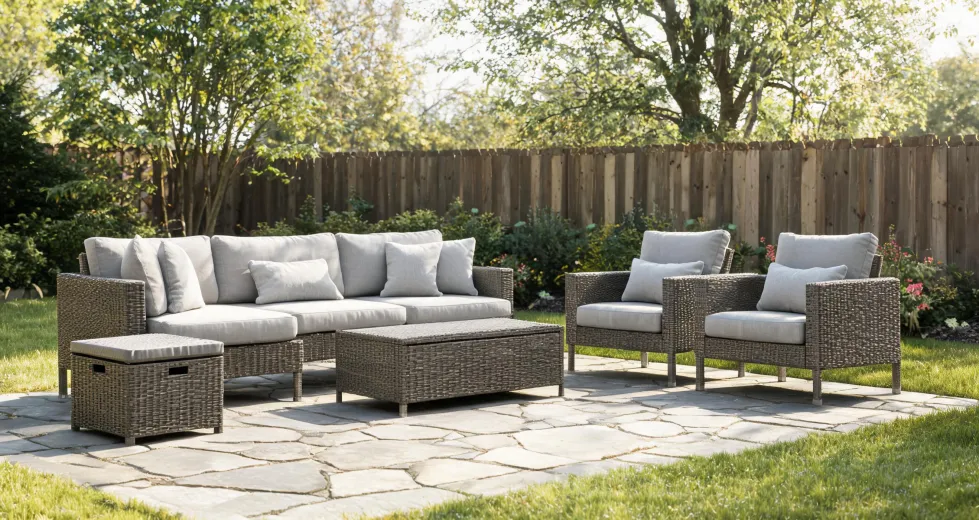
Two carts, one patio. On the left, the 5 Pieces Outdoor Sectional Sofa with Updated Metal Base at $444.99. On the right, the 6 Pieces Outdoor Sectional Sofa, U shape, listed at $599.99 and marked to $489.99. Both fit a three-meter corner, both seat four comfortably, and the gap between them is about $45. Neither wins on all three things you actually feel: how much floor the set eats, how tight the frame still feels after a wet season, and how much one seat costs you. Decide which of those you will give up first.
5 Pieces or 7 Pieces: What to Compare First in a Wicker Patio Conversation Set
Open the store page and the loudest labels are piece counts and percentages. A BEST SELLER badge sits on the Patio Dining Set 9 Pieces & 11 Pieces at $699.99, cut from $499.99, while -47% hangs on a 7 Pcs sectional with an ottoman and -5% on the 3 Pieces Patio Bistro Set with Coffee Table at $169.99. Nothing in that grid tells you how the frame is built, how much assembled run the set occupies, or whether the cushions can be stacked away. The page is organised for browsing, so the first filter it hands you matters least.
Piece count does set the price ladder, and the ladder is wide: $169.99 for the 3 Pieces Patio Bistro Set, $199.99 for the 4 Pieces Patio Furniture Set, $619.99 for the 7 Pcs Outdoor Sectional Sofa with Ottoman, and $649.99 for the 7 Pieces Sectional Sofa with Updated Metal Base. Two seven-piece listings, $30 apart, separated by base naming rather than seating capacity, which is the tell that the number in the title is a price signal before it is a comfort signal. What does not scale with piece count is how the frame takes load: that is the variable you feel in year three.
The question here is narrow: in what order should you compare, and what do you give up when the budget cannot buy all three? The order used below is form first (conversation set or sectional), then base construction, then piece count and footprint, then price tier and discount. Two situations fall outside it. The first is a balcony or porch with under roughly two meters of usable run, where a three-piece bistro set is the ceiling rather than a starting point. The second is a shared installation where furniture is rearranged weekly and nobody owns the cushions. If either describes you, the piece count table is your stopping point.
Same Five Pieces, Two Bases: Updated Metal Base vs Updated Plastic Base
A sectional is a load path, not a sofa. Weight travels from the seat platform into the frame rails, from the rails into the base or the feet, and from there into the pavers. The listing names track that joint: Updated Metal Base on the 5 Pieces Outdoor Sectional Sofa at $444.99, Updated Plastic Base on the same five-piece configuration at $399.99, and Metal Feet on the 6 Pieces Sectional Sofa at $599.99 with -18%. Metal resists the small lateral twists that surface as a rocking arm after a season of use; a plastic base panel flexes with them. The hidden part decides whether the armrest still feels tight in month eighteen.
Put two adjacent listings side by side and the naming stops looking like marketing. Two seven-piece sectionals sit $30 apart: the 7 Pieces Outdoor Sectional Sofa with Updated Metal Base in blue at $649.99 carrying -8%, and the 7 Pcs Outdoor Sectional Sofa with Ottoman in beige at $619.99 cut to $569.99 with -47%. Same seating family, same wicker look, a 39-point gap in discount. On the five-piece pair, the metal-base version at $444.99 shows Sold Out while the plastic-base version at $399.99 still adds to cart. Read that as demand rather than a quality verdict: buyers who compare titles reach for the metal-base SKU first.
Stable is not a spec you can read from a photo, so reduce it to a checklist. Find the base wording in the exact product title (Updated Metal Base, Updated Plastic Base, Metal Feet), because those strings identify different assemblies, not colors. Confirm the same string appears on the variant you actually buy, since one five-piece configuration exists under two titles at two prices. Check what carries load where two sections join, because that junction takes the highest twist. Ask whether the feet adjust, and what the base is coated with if the set stays outside year-round.
Piece Count vs Footprint: Which Configuration Fits Which Patio
Read a furniture grid in four columns, not two. Piece count belongs in the first column; what each increment adds belongs in the next three: a seat, an ottoman, or a corner table, how much assembled run the set occupies, and which price band the configuration lands in. The store page organises itself by form before size, separating SECTIONAL SOFA, PATIO DAYBED, CONVERSATION SET, DINING SET, LOUNGE CHAIR and UMBRELLA & CANOPY in the main navigation. The 5 Pieces, 6 Pieces and 7 Pcs listings sit inside that structure rather than above it, which hints at the order the shop expects you to decide in.
The collection counts settle a common mix-up. Patio Conversation Set holds 17 products and Patio Sectional Sofa holds 22, two parallel collections rather than one filtered list. Patio Daybed adds 4, Patio Umbrella & Canopy 5, Lounge Chair 9, Dining Set 13, Garden 21, out of 389 products in total. That structure matters because the five-piece sectional at $399.99 or $444.99 and the conversation-set configuration you searched for are siblings in the catalog; the store is not treating one as the upgrade of the other. Choose the form for how you sit: a sectional wraps a corner, a conversation set squares off around a table. Only then let piece count argue.
Enough seating is a definition problem before it is a measurement problem. Define it by the number of people who use the space on an ordinary weekday, not by the largest group you might host twice a summer. If four people sit out regularly, a five-piece configuration covers them with a spare spot beside the arm; a sixth and seventh seat duplicate that capacity for a handful of evenings while costing floor space every other day of the year. The ottoman follows the same logic: it is one seat and one footrest, so it earns its place only if it gets used where it sits. Count residents first, guests second.
$169.99 to $699.99: Why Discount Percentages Never Line Up With Price Tiers
Spread the patio seating catalog from cheapest to dearest and the bands appear in order: $169.99 for the 3 Pieces Patio Bistro Set with Coffee Table, $199.99 for the 4 Pieces Patio Furniture Set, $229.99 for the 3 Pcs Outdoor Rocking Chair Set, $309.99 list on the Chaise Lounge Sets before their markdown to $189.99, then $444.99, $569.99 to $619.99, and $649.99 near the top of the sectional range. Piece count tracks those bands closely enough to work as a rough price guide. What the bands do not tell you is which listing is a good deal, because the percentage beside a price is set by the markdown calendar rather than the tier.
Line the badges up and the pattern inverts. The 3 Pieces Patio Bistro Set at $169.99 carries -5%, the cheapest listing in the group with the shallowest cut. The beige seven-piece with the ottoman carries -47%, the deepest discount on the page, while the 7 Pieces Sectional Sofa with Updated Metal Base at $649.99 carries only -8%. The 6 Pieces Sectional Sofa with Metal Feet shows -18%, and the 9 & 11 Pieces Patio Dining Set at $699.99 carries -29% against $499.99. If percentages tracked quality or tier they would climb with price; they do not. Sorting this page by discount sorts it by clearance rhythm.
So when is a percentage worth acting on? Treat it as information only when something structural arrives with it: a discontinued color, a Sold Out sibling at the same size, or a collection tag filing the item under Clearance rather than New Arrival. The products page hands you the tools to check: Sort by Price, low to high, Price, high to low, Date, old to new and Best Selling share one dropdown, and the flat 5% OFF With Code devosale applies on top of any tier. A -47% cut on a current best seller and a -47% cut on a discontinued color look identical in the grid; the color name and the flag separate them.
The Seating Set vs the Whole System: Accessories That Decide Usability
Filter the catalog by collection and the furniture becomes one component of a system. The same counts return in a different light: 17 conversation-set listings, 22 sectionals, daybed 4, umbrella and canopy 5, inside a 389-product catalog that also runs Clearance 15 and New Arrival 27. The seating you are pricing is roughly one tenth of that list. The ratio is the argument for reading the accessory collections before checkout: the conversation-set listings are the part people debate, while the shade and storage items in the neighbouring collections decide whether cushions are dry enough to sit on in July. Budget for the system, then allocate to the seats.
Storage and shade change the usable life of a wicker set more than an extra seat does. Cushions left on the frame through a wet season are what turn a tight arm into a sagging one, and the answer is a box sized for them: the 82 Gallon Storage Patio Bench and Deck Box lists from $179.99, in UV-resistant polypropylene with a reinforced lid rated to 800 lbs that doubles as seating. A separate 85 Gallon Resin Wood Look Deck Box sits at $99.99 with a 660 lb seat capacity if you only need volume. Shade decides how many hours a season the set is used at all: the 10 Ft Patio Cantilever Umbrella lists at $109.99. Storage plus shade lands near $210 to $290.
The boundary of what a catalog page can tell you is worth naming. Nothing in that listing resolves cushion thickness, fill density, frame alloy, or the weather rating of the wicker weave, and those are the parameters deciding how the set feels in year three. Treat the gap as a pre-purchase checklist rather than a reason to stall: measure your usable run, confirm the base wording on the cart line itself, ask what the cushions are filled with, and ask what the frame warranty covers when the set stays outside through winter. Anything a listing answers only with a photograph needs your own verification.
The Decision Rule: Three Checks Before You Compare Price
Back to the two carts. If your corner runs about three meters, four people sit out most evenings, and the budget sits between $400 and $600, the five-piece configuration is the defensible pick: $399.99 with the Updated Plastic Base or $444.99 with the Updated Metal Base. The six-piece U-shape at $599.99, marked to $489.99, buys one more seat and a longer assembled run, and it earns that extra spend only if the fifth and sixth seats are occupied on ordinary weeknights rather than twice a summer. Availability may settle the argument for you: the metal-base five-piece shows Sold Out while the plastic-base version still adds to cart.
Here is the rule to carry away. Step one: choose the form before the size, corner-wrapping sectional or table-facing conversation set, since those are separate collections whose piece counts do not convert. Step two: read the base wording in the product title (Updated Metal Base, Updated Plastic Base, Metal Feet) and check that the same string is on the item you add to cart. Step three: set the piece count from the number of people who sit outside on a normal weekday, and check the discount badge last, once the first two steps narrow the list. In that order, the percentages stop deciding for you.
The rule has edges. It assumes you can move the set and that someone is around often enough to store cushions after rain; at an exposed site used a few weekends a year, a cheaper set with covers and a rigid box may beat a heavier configuration you cannot protect. It assumes a run of at least two meters: below that, the three-piece bistro set at $169.99 is the ceiling rather than an entry point, and stacking extra pieces blocks the door. It also assumes residential use, where a shared terrace rearranged weekly should be judged on weight and anchoring rather than on how cushions store.
One sentence to keep: pick the form, verify the base wording on the listing you actually order, then set the piece count from your resident headcount, and read the discount badge last. That order settles the case this article opened with, where about $45 separates a five-piece and a six-piece set and the base naming, not the seat count, is what you feel two summers later. Where the rule stops holding, the accessory budget matters more than the seating spec.

Ingrid Falk
Ingrid Falk is an outdoor living products analyst specializing in fences, pergolas, gazebos, canopies, greenhouses, shade sails, patio sets, outdoor sofas, and weatherproof cushions. She uses ISO 4892-2 and ASTM G154 weathering methods while comparing UV color change, coating adhesion, corrosion resistance, frame load, joint stability, water shedding, and dimensional movement. Her work helps garden retailers, project buyers, and hospitality operators select structures and furniture suited to wind exposure, climate, installation method, maintenance, and expected occupancy.