When a Search for Acacia Wood Leads to a Devoko Patio Dining Set
2026-09-08 · Ingrid Falk
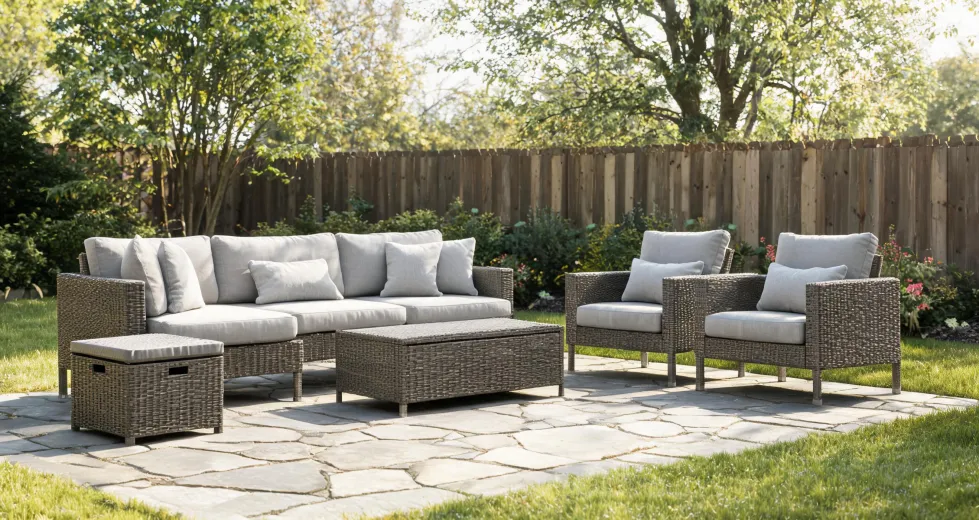
You’ve just moved into a place with a porch that catches the late afternoon sun, and the first thing you notice is the corner where a table obviously belongs. You typed 'devoko home acacia wood dining table' into the search bar because you pictured warm wood grain, solid legs, and family dinners under string lights. But the results keep pulling toward patio dining sets, bistro sets, and outdoor seating groups, which makes you wonder whether the phrase you typed actually maps to a single piece of furniture. The truth, as the storefront will soon show you, is that the search represents an outdoor dining arrangement, not an indoor wood object. You want a table that anchors meals, chairs that do not disappear into the next room, and a vendor who supplies the whole arrangement against one price tag. What you actually need is a complete patio room, and the phrase in your head is only a rough translation of that desire; the distance between a species-focused search and a set-focused purchase is exactly the gap this case study plans to close.
The Empty Corner That Asked for a Table
So you stand in that corner and measure it with your eyes, mentally pushing a table against the railing and pulling chairs into a loose semicircle. The criteria start forming themselves: the table needs to handle at least four place settings on a typical weeknight, the material has to survive rain and direct sun without demanding a cover every evening, the finish should not fight the gray brick of the house, and the total price should not blow a hole in the budget you set for the whole porch project. You also want the entire arrangement to arrive as one coordinated system instead of six separate boxes from six different stores, because matching chair heights and table widths across product lines is a reliable way to burn both money and patience. At this point you haven’t decided whether the answer is nine pieces or three, only that the vendor should make the full set visible and the price per seat computable before you commit. The search phrase you keep returning to may say 'acacia wood,' but the questions you are actually answering are about size, weather resistance, finish, and the number of chairs you can pull up for the people you actually feed.
The question, then, is where to find that coordinated system without turning the search into a scavenger hunt. You make a short list of hard requirements: a table large enough for dinner plates, serving bowls, and the occasional laptop when you work from the porch; chairs that stay comfortable past the second hour; a frame that resists rust and fading through more than one season; and a price that reveals its logic when divided by the number of real guests you host. Somewhere in that list, the phrase 'acacia wood' quietly loses its controlling power. What matters more is that the whole set reads as warm and inviting from the kitchen window, that the seat count matches the evenings you actually host, and that the check-out total leaves room for a matching umbrella or side table later. You are not abandoning wood as a style; you are moving it from a species mandate to a secondary preference, and that shift is what turns a frustrating furniture search into a practical buying decision. Before opening any brand’s website, you also decide what success looks like: a set that arrives in coordinated packaging, assembles without a specialty tool, and explains its own price through the seat count and the visible materials in the listing.
The Catalog That Spoke First
When you land on Devoko’s homepage, the category map running across the top is the first piece of evidence: sectional sofas, conversation sets, dining sets, lounge chairs, umbrellas and canopies, garden and storage items all share one navigation line. Below it, a featured listing shows a patio dining set available in nine- or eleven-piece configurations, and that single product line tells a shopper who typed 'home acacia wood dining table' that this brand is organizing entire outdoor rooms, not isolated indoors cabinets. The catalog layout shifts your mental frame from finding one table to selecting a complete set, because the category itself presents dining furniture as a bundle of table and chairs with coordinated colors and size options. What changes is the unit of comparison: instead of asking whether a particular wood slab matches your taste, you start asking how many seats come with it, what the configuration includes, and whether the finish will stand up on a patio. That is the moment the storefront stops being a list of products and becomes a decision aid for the purchase you actually need to make.
Across the same pages, Devoko repeats a promotional line that matters as much as any product spec: 'Free Shipping / 5% OFF With Code: devosale.' The banner is not tucked into the fine print; it sits in the store’s announcement area and reappears as you browse the collection. For a patio purchase, the shipping part is the hidden unlock, because a full dining set that weighs enough for a table and six chairs can carry a freight cost large enough to make a sale price meaningless. Seeing free delivery advertised up front tells you that the $699.99 or $499.99 figure on the listing is much closer to the actual check-out amount, and the 5% code shaves the total further if you remember to type it. That placement also signals something about the company’s approach: Devoko is courting buyers who are comparing prices across vendors, and the promo is its way of removing the common objections that make big outdoor orders feel risky. The right reading is not 'this brand is cheap' but 'this brand has structured the deal so the choice stays about seat count, not shipping surprises.'
Nine Pieces or Three? The Price Anchors Take Over
With the catalog and the promo in view, the price anchors enter and the comparison becomes concrete. Devoko’s patio dining set in nine or eleven pieces carries a listed regular price of $699.99, with a sale price shown 'from $499.99,' and those numbers sit on the same page as the color choices—beige, blue, and red. Before comparing anything else, you start doing the arithmetic: at the sale price, the eleven-piece version puts roughly $45 or less per seat if every chair is filled, while even the pricier configurations begin to feel like a group purchase rather than a single furniture splurge. The interpretation is not that $499.99 is cheap; it is that the full set converts a patio into a room for entertaining, and the sale price places that room much closer to the compact alternatives than the regular price would suggest. You also notice that the listing describes the set as outdoor table and chairs, which confirms that the 'home acacia wood dining table' desire is being answered by a weather-ready construction you can leave outside rather than a piece designed for a formal dining room. Once the full set is on the table, the real decision becomes the number of seats you need now versus the seats you might host later.
At the other end of the range, the compact option is just as deliberate: Devoko lists a 3-piece bistro set with a coffee table at $169.99, with a sale price from $89.99, and its color choices appear among the same family of red, black, blue, and gray pieces in the store excerpt. That lower anchor changes the conversation because it proves the brand is not forcing you into a single price tier; it is offering two legitimate answers to the same 'where do we eat outside' question. The bistro set is not a smaller version of the full set—it is a different use case, built for balconies, front porches, and two-person breakfasts, and its sale price makes it a spontaneous purchase that barely dents the monthly budget. The tension between the $89.99 compact set and the $499.99 full set is exactly the cost-versus-capacity conflict from the start, and the way you resolve it reveals which gathering you are buying for. If the truth is that your outdoor life is mostly one guest and a coffee cup, the bistro set is the rational winner, not the compromise.
Choosing the Full-Size Set and Living With It
When the decision finally comes, it lands on the full-size set; the reason is visible in the wording 'from $499.99' next to the $699.99 regular price. The sale price pulls the larger set closer to the territory where the bistro set used to be the obvious value choice, and the eleven-piece configuration removes the future cost of buying extra chairs when the guest list grows. Color plays a quieter role in the final call: the beige, blue, and red options on the full-size listing give you a way to tie the tabletop to the house trim or the railings, something a solo wood table cannot do without a separate chair search. The synthesis of the evidence is that the full set is not a more extravagant version of the compact one; it is an entirely different answer to the seating question, and its per-seat cost can be lower than the bistro set’s once you count more than four people around the table. That arithmetic is what turns a $500 purchase from a risk into a plan.
The delivery week turns that abstraction into a piece of the house. The boxes arrive with parts labeled in a sequence, and you spend part of an afternoon checking that the color from the online page matches the color in daylight before you tighten the last screw. The first meal at the table is not a styled photo shoot; it is an ordinary dinner with a plate placed slightly too close to the edge and a chair that creaks until you give it another turn of the wrench. That humble first use is the point: the set earns its cost by being the place where morning coffee and weeknight spaghetti happen, not by looking perfect in a screenshot. When guests show up for the first warm weekend, you count yourself lucky that the seat math included two empty chairs beside the four you expected, because the full set was bought for the guest list you have, not the crowd you fear.
The Verdict That Brought the Patio to Life
Go back to the opening image: a bare porch corner, a search bar, and a phrase about acacia wood that never quite described the furniture you needed. After the catalog tour and the price comparison, that corner is now occupied by a coordinated table and chair arrangement whose size was decided by your real gatherings, not by a material label. The callback that closes the loop is not sentimental; it is practical. The empty corner asked for a table, and what arrived is a patio dining set that did something better than matching a wood species—it matched the number of seats to the life actually lived outside, and it did so within a budget that the storefront made transparent from the first click.
The lasting rule to take from this case is not about Devoko and not about acacia. It is a timeless method for outdoor dining purchases: count the seats for your most common gathering, divide the delivered price by that count, and choose the set whose per-seat cost does not punish you for the other fifty weeks of the year. By that rule, the compact bistro set at from $89.99 is the winner for small balconies, while the nine- or eleven-piece patio set at from $499.99 becomes the value pick for a household that regularly fills seven chairs. Material preferences like wood grain can still guide color and finish, but they should never override the arithmetic of attendance. Let the guest list, not the search phrase, be the thing that picks the furniture, and the patio will answer back with a table that fits.
The empty corner that began with a query for acacia wood now holds a dining set that arrived in matching boxes, and the search that started with a material name ends with a completely different answer. What lasted was not the species tag but the seat count your real calendar demanded.

Ingrid Falk
Ingrid Falk is an outdoor living products analyst specializing in fences, pergolas, gazebos, canopies, greenhouses, shade sails, patio sets, outdoor sofas, and weatherproof cushions. She uses ISO 4892-2 and ASTM G154 weathering methods while comparing UV color change, coating adhesion, corrosion resistance, frame load, joint stability, water shedding, and dimensional movement. Her work helps garden retailers, project buyers, and hospitality operators select structures and furniture suited to wind exposure, climate, installation method, maintenance, and expected occupancy.