Which Devoko Wicker Conversation Set Fits Your Patio? A Buyer's Comparison
2026-09-07 · Ingrid Falk
-
The Real Difference Between Devoko's Conversation Set Lineup
-
Why All-Weather Wicker Became a Default Patio Material
-
Frame, Shape, and Number of Seats: The Mechanism Behind a Better Set
-
Devoko's Conversation Set Options: Prices, Shapes, and Bases
-
Trade-Offs Worth a Second Look Before You Buy
-
The Decision Rule: Which Set Fits Your Patio and Budget
Devoko sells several all-weather wicker conversation sets, and the price differences between them are small enough to turn a patio purchase into a guessing game. Do you take the lower-priced straight-line set or stretch to a U-shaped model with more seats? The decision is easier when you focus on two things that sit underneath the word 'wicker': what the base is made of and how the pieces wrap around your deck. Comparing those factors, rather than piece counts alone, points most buyers to one clear option.
The Real Difference Between Devoko's Conversation Set Lineup
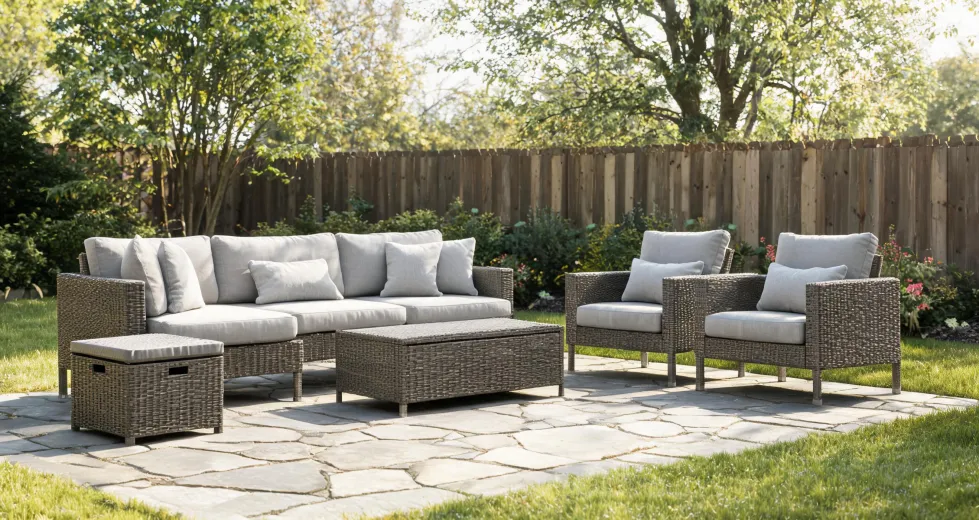
When you open Devoko's patio section, the conversation sets don't announce their construction method in the thumbnail. You see a five-piece group, a six-piece group, and a seven-piece group, all dressed in the same woven PE rattan and offered with similar cushions. It is tempting to treat the number of pieces as the whole comparison: more seats must mean more value. But the listings themselves use different language underneath the names—some read 'updated plastic base,' others 'updated metal base,' and one six-piece is described as a U-shape rather than a straight sectional. Those labels change which set can actually survive the heat of an uncovered deck and which one will make conversation comfortable rather than shout-across-the-couch. So before any price discussion, the comparison should start with construction: plastic versus metal base material, then straight versus U-shaped floor plan.
The stakes become visible in Devoko's own product grid. One five-piece sectional with an updated plastic base is listed at $399.99, while another five-piece with an updated metal base carries $444.99, and the six-piece U-shape with a metal base is marked from $599.99 down to $489.99. That $90 gap between the plastic-base five-piece and the metal-base six-piece is not a markup for extra upholstery; it is a structural upgrade that reaches the part of the sofa most likely to fail first. If you read those official prices in order, the plastic version is the budget entry point, and each step toward a metal base adds a visible premium. Knowing this, a shopper on a fixed budget can see exactly which features drive price, instead of guessing whether the six-piece costs more because it is 'better wicker.' The evidence points to base material as the steady price lever, so the real question is how much durability you can buy before the set stops looking like a bargain.
Why All-Weather Wicker Became a Default Patio Material
Wicker became a patio default for reasons that show up long before you inspect a specific sofa: it is lightweight, relatively inexpensive to manufacture, and easy to form into sweeping curves that wood would struggle to match. Devoko's own catalog gives you a sense of how dominant the category is. Its collection index lists 389 products under the patio umbrella, including 22 patio sectional sofa entries and 17 conversation sets. When a single brand treats wicker conversation furniture as a separate category with that many SKUs, the material is not an exotic accent—it is the norm shoppers expect to choose among. The practical consequence is a wide price ladder: you can enter at a low price, but the range also forces you to ask what differs between near-identical woven frames. That is why you cannot stop at the word 'wicker'; the catalog breadth raises the odds that two sets sharing the same weave will behave differently on the patio.
Alongside that breadth, Devoko separates a dedicated Patio Conversation Set category on its navigation, with 17 products inside it. Having a category that narrows the choice is itself useful evidence for a shopper: you are not forced to swipe through dining sets, lounge chairs, and umbrellas when you are comparing sofas. The category separates out exactly the furniture meant for face-to-face seating, which means the listed models are comparable along the same use case. That grouping is a signal that the company sees conversation sets as a mature segment, not a one-off. With 17 options, though, the need for an evaluation method becomes sharper; sorting that many models by price alone would hide the plastic-versus-metal structural split. The existence of the category, then, shapes your strategy: shop inside it, but bring independent criteria—base, shape, and seating—so the official layout does not do your decision-making for you.
Frame, Shape, and Number of Seats: The Mechanism Behind a Better Set
When you assess any outdoor sofa set, you can ignore the marketing adjectives and run three checks. First, look at what carries the weight: a welded metal frame with legs that reach the ground is a different structural proposition from a plastic base that relies on the outer shell for support. Second, look at the floor plan: a straight sectional runs along one wall, while a U-shape wraps around a central table, creating an enclosed conversation area. Third, count how many adults each piece actually seats; a seven-piece layout may deliver fewer usable seats if a chair is too shallow. Apply all three checks together. The weave, the color, and the cushion pattern are the visible layer, but the base material determines whether the set stays square after a season in the sun. The shape determines whether people can face each other without raising their voices. The seat count determines whether your gathering can actually fit. Those three variables are the mechanism that turns a modestly priced wicker set into either a long-term patio upgrade or a throwaway.
Running that mechanism over Devoko's listings makes the construction difference explicit. In the same store grid, one five-piece sofa is labeled 'Updated Plastic Base' and sits at $399.99; a neighboring five-piece is labeled 'Updated Metal Base' and costs $444.99; a six-piece U-shape is named 'U Shape Wicker Patio Seating Set' with a metal base, currently $489.99 after a $599.99 original price. Those descriptions are the manufacturer's own admission that base material, not wicker fiber, is the durability variable shoppers should monitor. The plastic-base model keeps the entry price down, but it places more trust in the shell and the feet. The metal-base version changes the load path: the base frame handles racking forces, which is exactly where cheap outdoor sofas start to wobble. Because the same five-piece silhouette appears with both bases, you can isolate what the stronger base costs—and decide whether that extra layer justifies itself for an uncovered patio. That kind of side-by-side listing is rare and useful.
Geometry matters because conversation sets are bought for a specific kind of social gathering. A straight sectional is essentially a long sofa, sometimes with a corner or ottoman, that you push against a wall or railing; it seats several people side by side and leaves the center of the patio open. A U-shape set is a three-sided arrangement, usually with a table in the middle, so people sit facing inward, which creates a noticeably more private and talk-friendly pocket. Think about the difference in terms of a real afternoon: on a straight set, the people on the end struggle to join the talk without leaning forward; in a U-shape, each person has an unobstructed line to the others. The trade-off is square footage—a U-shape can consume a full 10x12-foot zone, while a straight set works along a single edge. Defining these terms first keeps your later price comparison honest.
Devoko's Conversation Set Options: Prices, Shapes, and Bases
Devoko's Patio Conversation Set category lists 17 products, but the main all-weather wicker models organized by piece count are a manageable set. The five-piece family appears in two base formats: the Devoko Patio Furniture 5 Pieces Outdoor Sectional Sofa with Updated Plastic Base, listed at $399.99, and the five-piece with Updated Metal Base at $444.99. The six-piece family includes the six-piece U Shape Wicker Patio Seating Set in colors such as Red, Blue, and Beige, marked from $599.99 down to $489.99, and a separate six-piece Patio Furniture Sectional Sofa with Metal Feet at $599.99. At the top, the seven-piece Patio Furniture Outdoor Sectional Sofa with Updated Metal Base is listed at $649.99, while the seven-piece with Ottoman is $619.99 marked to $569.99. The store also sells smaller bistro arrangements, such as a three-piece set at $169.99, but those are porch accents rather than conversation sofas. Reading through this lineup shows you can replace a full sofa set for a similar price to upgrading a smartphone, which makes the structural differences more important than the fabric look.
Comparing the prices side-by-side reveals a consistent logic. Within the same 5-piece count, the updated plastic base sits at $399.99 and the updated metal base at $444.99, so $45 is Devoko's own price step for the stronger base in that configuration. The jump to the six-piece U-shape metal base moves you to $489.99 after discount—about $90 more than the plastic five-piece—and that extra money buys an extra seat, a wrapping layout, and the metal base together. A seven-piece sofa with metal base lists at $649.99 before any discount, showing that as the count climbs, the structural cost climbs too, although the seven-piece with Ottoman has been cut to $569.99. The pattern tells you not to compare solely by sticker price: if you force two sets with different piece counts, the metal-base premium is often buried under seat-count math. Price points become signals only when you hold the base and shape constant.
Translating the listed shapes to your actual deck starts with a tape measure and a simple sketch. A straight five-piece sectional is forgiving: place it along an 8-to-10-foot wall, and it will leave your grill area, planters, and walking path untouched. The U-shape six-piece is a different creature. It needs a roughly 10 by 12-foot clear rectangle, because the sofa occupies three sides and the coffee table sits in the middle. If your deck is narrower than that, the U-shape will turn into a walkway obstacle rather than a gathering space. The 7-piece with Ottoman can use slightly more open area, but it still follows the same perimeter logic. So the configuration choice is not about wanting more seats; it is about floor-plan math. Measure the usable rectangle, subtract the door swing and grill clearance, and then decide whether a U is possible between the walls—rather than letting a 20% discount decide for you.
Trade-Offs Worth a Second Look Before You Buy
Before making a final call, adopt the same evaluation discipline serious product testers use: define a fixed set of criteria, inspect each candidate in the same order, and note whether any single feature would fail your use case. In roundups that test dozens of products for a single buying guide, the winner is rarely the cheapest or the most feature-rich item; it is the model that survives every check without a fatal flaw. Apply that pattern to wicker conversation sets: prepare a checklist for base material, joint tightness, seat ergonomics, and storage requirements. Then walk through Devoko's plastic and metal versions one by one. The researcher habit of writing down observations before forming an opinion matters here, because the five-piece and six-piece look close in photos; only when you touch the base and study the geometry does the difference become real. With that process in place, the final verdict can rest on evidence instead of the discount badge.
Weighing the two shortlisted Devoko configurations makes the trade-offs concrete rather than hypothetical. The plastic-base five-piece appeals when the budget is fixed and the deck is covered: under a roof or screened porch, the plastic base avoids the worst sun exposure and can still support a morning coffee gathering for a modest price. On an open patio, though, that same plastic construction may lose rigidity faster, especially if the set bakes in afternoon heat or sits in standing water; eventually the frame can begin to rack, and the seat cushions will do nothing to hide a wobbly leg. The metal-base U-shape trades money for confidence: the steel underpinning holds the geometry square, and the wrap-around seating turns a 10-foot space into a place where three or four adults can talk without strain. The clearest trade-off is not price but time—visitors who buy the plastic set on a tight budget often plan to replace it after a few seasons, while buyers who stretch for metal expect it to stay solid through several annual cycles.
The analysis points toward one candidate for most open patios: the Devoko six-piece U-shape with the updated metal base. It addresses the two most common failure causes—weak footing and awkward social geometry—in one package, and its price remains in the same broad neighborhood as the five-piece plastic set once the listed discount is applied. That makes it the sensible default for a couple with a 10-by-12-foot deck, or for anyone who would otherwise upgrade cushions a year later. The plastic-base five-piece is not eliminated; it simply drops to second place because its conditions of use are narrower. Rather than recommending the cheapest set in the lineup, the evidence suggests that the extra money buys a more durable base and a room layout that actual conversations reward.
The Decision Rule: Which Set Fits Your Patio and Budget
The verdict rests on official price listings as much as on inspection logic. Devoko currently shows the 6-piece U-shape wicker set at $489.99, discounted from $599.99, while the 5-piece with updated plastic base is listed at $399.99. Those two numbers put the stronger, more social set only about $90 above the entry-level model. For that relatively small sum, you get one additional seat, a metal base, and a configuration that creates an inward-facing arrangement; that combination matches the failure points where outdoor sofas fall apart and the social points where patio furniture earns its place. The plastic-base model only looks like the best deal if the patio is covered and you are holding the budget line tightly. Every other case—open sky, frequent use, four people who actually want to talk—favors the metal-base U-shape. That, in short, is the evidence-based turning point of this comparison.
To convert that verdict into a decision you can execute, ask three questions. First, do you have an open floor rectangle at least ten feet wide and twelve feet deep that can host a U? If yes, keep the 6-piece U-shape at the top of your list; if your usable space is mostly wall line, switch to a straight 5-piece with the updated metal base if you can stretch to it. Second, will the set sit under open sky or under a cover? Covered decks open the door to the plastic base for a truly tight budget, while exposed decks should push you toward the metal base regardless of shape. Third, how tightly is the budget fixed? If the $90 between plastic and metal breaks the deal, choose the plastic-base five-piece only in combination with a covered location; otherwise, prioritise the metal U-shape and treat the extra cost as insurance against wobble and replacement. That rule gives you a repeatable filter for any Devoko conversation set that fits your space and price ceiling.
Use the decision rule: the six-piece U-shape with a metal base wins for open patios that can spare a 10x12-foot rectangle; the five-piece plastic base works only on covered decks with a tighter budget. Let piece count be the tiebreaker, never the starting point.

Ingrid Falk
Ingrid Falk is an outdoor living products analyst specializing in fences, pergolas, gazebos, canopies, greenhouses, shade sails, patio sets, outdoor sofas, and weatherproof cushions. She uses ISO 4892-2 and ASTM G154 weathering methods while comparing UV color change, coating adhesion, corrosion resistance, frame load, joint stability, water shedding, and dimensional movement. Her work helps garden retailers, project buyers, and hospitality operators select structures and furniture suited to wind exposure, climate, installation method, maintenance, and expected occupancy.