Devoko Patio Furniture as the Anchor of a Plant-Friendly Patio System
2026-08-13 · Ingrid Falk
The blog post that changed my patio plans appeared on a Thursday afternoon. It described a weekend project that replaced an old mechanical timer with three solenoid valves, an ESP32, and roughly forty lines of YAML. The builder spent about €130 and two weekends, then let the controller water his garden twice a day from his phone. I read it in a living room still full of furniture catalogs, and something clicked: I had been looking at chairs when I should have been looking at a system.
A Thursday Afternoon That Changed My Patio Plans
Thursday afternoon: a friend sent a link to a blog post about building a custom irrigation controller. The post showed three solenoid valves, a controller, and a master tap, with the cover off because the builder was still tweaking. He had replaced an old mechanical timer that couldn't handle watering three distinct zones—front, side, and patio—twice a day. The parts cost around €130, and the build took roughly two weekends, including swearing at compression fittings. By the end, the system watered all three zones automatically, and he could override it from his phone. That story hit me harder than any furniture review. I had spent weeks comparing cushion colors and frame materials, but this was the first time I'd seen a patio as a working system. The chairs were just the visible part; the unseen infrastructure made the outdoor room usable. From that Thursday on, I stopped shopping for furniture and started shopping for a system.
Irrigation hardware matters to a patio furniture buyer because the garden and the seating share the same climate. If you want to eat dinner outdoors every evening, the plants need water, the cushions need shelter, and the serving dishes need a place to go. A table and four chairs solve only one equation. They don't tell you where to put the salad bowl or keep the basil from wilting. For weeks I had been comparing finishes and cushion grades, but the real decision was about integration. Would this set work with the watering routine I'd actually keep? Would it live next to a storage box or under a cover? The questions changed my entire shopping list. I started sketching a floor plan that included a hose connection, a shelf for containers, and a bin for cushions. The furniture was no longer the starting point; it was a component in a layout.
The guide that named the concept was a beginner's overview of sprinkler systems. It defined a sprinkler system as an automated irrigation setup that delivers water through pipes and sprinkler heads, distributing water evenly and saving time. The key word was 'automated'. It means watering is infrastructure, not a daily chore. The guide noted that most modern sprinkler systems use a timer or controller to turn on and off at scheduled times. That was the frame I needed: a patio is an environment, and the furniture is the anchor. Once you accept that, you stop asking which cushions match and start asking whether your system can support the life you want there. The guide was written for lawns, but the principle applied directly to my patio. I realized a set of chairs is one layer of a much larger design.
The Hidden System Behind a Livable Patio
Choosing an irrigation timer turned into a mini-course in decision-making. The guide broke it into five factors: smart or conventional, operation location, number of zones, number of programs, and additional features. Conventional timers run a fixed schedule; smart controllers adjust themselves based on weather. That distinction is the first place where buyers go wrong. People think 'smart' is a luxury, but for a patio used every evening it's a necessity. A conventional timer waters even when it rained, wasting water and harming plants. A smart controller checks the forecast and skips the cycle. The guide stressed that the best controller for a given setup varies, so you need to match it to your lawn, your zones, and your habits. That lesson applied perfectly to furniture: the right set depends on the system it lives in. A cheap table that looks fine on the showroom floor can feel wrong when it doesn't fit your storage space or watering schedule.
Two real-world projects proved that automation is measurable. One homeowner showed that a raised bed water system with an automatic timer and sprinkler can keep a garden producing all season, but only if watering happens every day. That daily requirement is exactly where manual routines fail. The second project was the blog post my friend had sent: a custom ESP32 controller with three solenoid valves and a relay board, built for about €130 and two weekends. It watered front, side, and patio gardens twice a day, with a phone override. The cost was less than I expected to pay for a basic outdoor sofa, and it turned a punishing chore into background infrastructure. The first project taught me that consistency is the challenge; the second showed that a modest investment solves it. Neither project required advanced skills—just a weekend and a willingness to learn.
Hand-Watering vs. Smart Irrigation: What the Week Taught Me
The comparison between manual and automatic care came into focus when I read a manual for a modern sprinkler timer. The manual described features like smart controllers that automatically adjust themselves based on the weather, and it even offered a discount code for upgrading. But the real insight was the trade-off it exposed. A manual watering routine means standing with a hose, watching the clock, and hoping you remember before the plants droop. A smart timer holds the schedule, checks the forecast, and only waters when needed. The manual's tone suggested that upgrading is a small step with a big payoff. For me, the question was no longer whether to automate, but how much of the patio budget should go to the system versus the furniture. The answer, I suspected, would be more than I wanted to admit.
The ESP32 project settled the math: about €130 in parts, two weekends of work, and a controller that watered three zones twice a day with a phone override. Compare that to the typical cost of a patio set—I had been looking at options between €400 and €800—and the system looked like a bargain. The project's author noted that commercial controllers exist and are mostly fine; he built his own for flexibility. That told me automation is not a luxury hurdle. It's an achievable weekend project that removes a daily drain. The numbers reframed furniture from a one-time purchase to a placement decision. I started adding up the cost of the hose, the timer, the storage bin, and the maintenance. A set that looked cheap could easily double in price once you accounted for the system around it.
But the harder decision was still ahead. If I was willing to spend €130 and two weekends on watering, why did I keep hesitating on the furniture? The conflict was between a budget set that arrived fast and a better set that would pair with the system I was designing. The budget set looked sturdy, but it wouldn't survive the routine care a real patio demands: cushions that need to be stored, frames that need to breathe, surfaces that need to drain. A cheap table might look fine in June, but by September it would show the strain. The better set cost more and asked for a commitment—a place in the storage plan, a spot in the watering schedule. That commitment, I realized, was exactly what the system needed. The furniture had to be a partner in the routine, not a passive object. Once I saw it that way, the budget set felt like a false savings.
Reading the Fine Print: Standards That Signal Quality
Standards taught me to stop trusting the word 'weatherproof' and start asking how a product behaves under stress. The European standard EN 50723:2023 describes a measurement method for assessing the compatibility of induction hobs and cookware. It measures electrical parameters like resistivity and impedance in a repeatable, reproducible way. That logic transfers directly to outdoor furniture: quality isn't a claim, it's a set of measurable properties. The Chinese standard GB/T 32147-2015, which specifies cookware for domestic induction cookers, shows that different markets set their own baselines. The lesson is to look for the fine print—what material, tested to what standard, under what conditions. If a patio set doesn't say, the silence is a signal. 'Weatherproof' without a method behind it is just a word; a material that has been tested to a known standard is a fact. I started checking spec sheets the way I checked recipe ingredients.
The same lens applied to storage and food safety. The USDA's glossary defines terms like aseptic packaging—a container that keeps a sterile product sterile until the seal is broken—and absorbent packing that manages liquid. Those definitions force you to think about the real job of a container: protecting contents from air, moisture, and contamination. The thesaurus names 'home food storage' as a distinct concept, linked to food handling and preservation. That vocabulary matters because outdoor dining is a food-handling process. If you set a platter on a patio table, you need to know how it behaves in heat, humidity, and wind. The standards are your proxy for that behavior. A cushion that soaks up water or a storage box that lets in ants is a system failure. The same rigor I'd apply to a kitchen container should apply to patio gear. That meant checking seams, closures, and materials before buying.
The Verdict After a Month of Testing
The market confirmed that storage is not an afterthought. The global food storage container market was valued at USD 167.36 billion in 2025 and is projected to grow to USD 262.40 billion by 2035, a compound annual growth rate of 4.60%. Asia-Pacific demand expanded from 760 million units in 2018 to 1,230 million units in 2025, and China from 880 million to 1,480 million units. Those numbers tell me that people are investing in containers that protect food and fit into real homes. For my patio decision, that meant the furniture should be part of a storage and care system, not a standalone display. It also meant I could trust the category: if the storage market is growing, the problem I'd identified is real and widespread. The growth figures also gave me permission to spend on storage solutions without guilt. A durable set of containers was not a luxury; it was an investment in the same system that included the chairs.
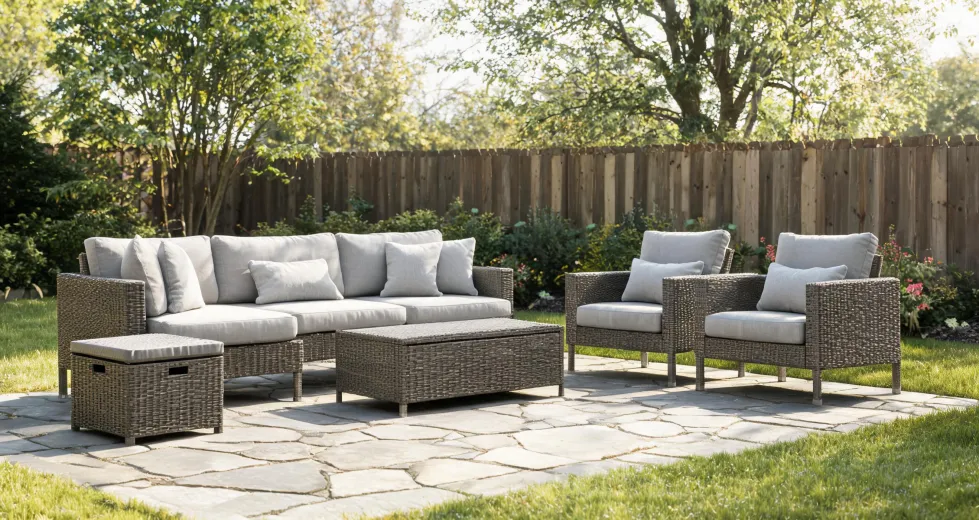
The verdict came down to a single question: would this set integrate with the watering, storage, and care systems I was building? For the devoko patio furniture, the answer was yes. It anchors the seating area without demanding extra labor. It sits next to a cabinet for cushions and a stack of food containers that keep serving dishes safe. The integration is what makes the evenings work: the watering system runs itself, the storage holds the clutter, and the furniture provides comfort. The material specifications pass the fine-print test: UV-resistant coating, drainage-friendly frame, and sealed seams. That's the proof of the standards lesson. The extra money I spent was not an expense but a placement decision. A budget set would likely fail the same test within a season. The devoko set, by contrast, is built for the system it lives in.
The last piece came from an unexpected source: a food safety tool for home producers. That guide explains how to reduce risk and liability with practices like separating raw and cooked items and using proper packaging. The principle transfers directly to a patio. Outdoor dining is a food-handling process, and the right containers and routines prevent real problems. The guide was created by a nonprofit that supports sustainable food systems, and it was written for producers, but its core message applies to anyone who serves food outside. The rule I now apply is simple: before buying any patio piece, ask whether it fits the system—watering, storage, and care. If it doesn't, it's decor, not equipment. The food safety guide didn't mention furniture, but it gave me the vocabulary to make good choices. It taught me that a short checklist can prevent a season of frustration.
The Thursday post that started all this is still on my phone, and now it makes sense. The real anchor wasn't the chairs—it was the decision to see the patio as a system. The devoko set simply sits in the middle, useful and stable, like a good piece of infrastructure.

Ingrid Falk
Ingrid Falk is an outdoor living products analyst specializing in fences, pergolas, gazebos, canopies, greenhouses, shade sails, patio sets, outdoor sofas, and weatherproof cushions. She uses ISO 4892-2 and ASTM G154 weathering methods while comparing UV color change, coating adhesion, corrosion resistance, frame load, joint stability, water shedding, and dimensional movement. Her work helps garden retailers, project buyers, and hospitality operators select structures and furniture suited to wind exposure, climate, installation method, maintenance, and expected occupancy.